Contact Us
5 e1781608328170
Group 2

Technology Department

We believe that combining technical science with field experience has led to brilliant and innovative achievements beyond expectations.

DENA operates at the leading edge of drilling fluids additive formulation and process design to develop high-performance, competitive, and environmentally friendly chemical products.

In Technology Department, we are systematically working to improve product formulations and processes in full compliance with the ISO 9001 quality assurance system. This approach involves innovative and productive work cycles focused on knowledge-based research at our R&D center, beginning with fundamentals and continuing through application and performance qualification to address industrial challenges and meet customer needs through the development of practical and effective new products.

RD BW11 scaled

R&D Center and Performance Utility

  • To achieve these goals, we have made significant investments in laboratory and pilot testing equipment, drilling process simulators, and a team of experienced staff across our R&D, QC centers, and multiple laboratories (both on-site and off-site). These efforts are aimed at generating knowledge to create new technologies and products.
  • Our main organizational objective is to become a true partner for every active client—supporting their production and completion processes with tailored solutions, reducing operational costs, and respecting environmental standards.
  • At our R&D center, efforts are concentrated on developing new solutions in response to customer needs, particularly in the field of drilling additive products.
F 22 scaled 2

QC and Performance Laboratory

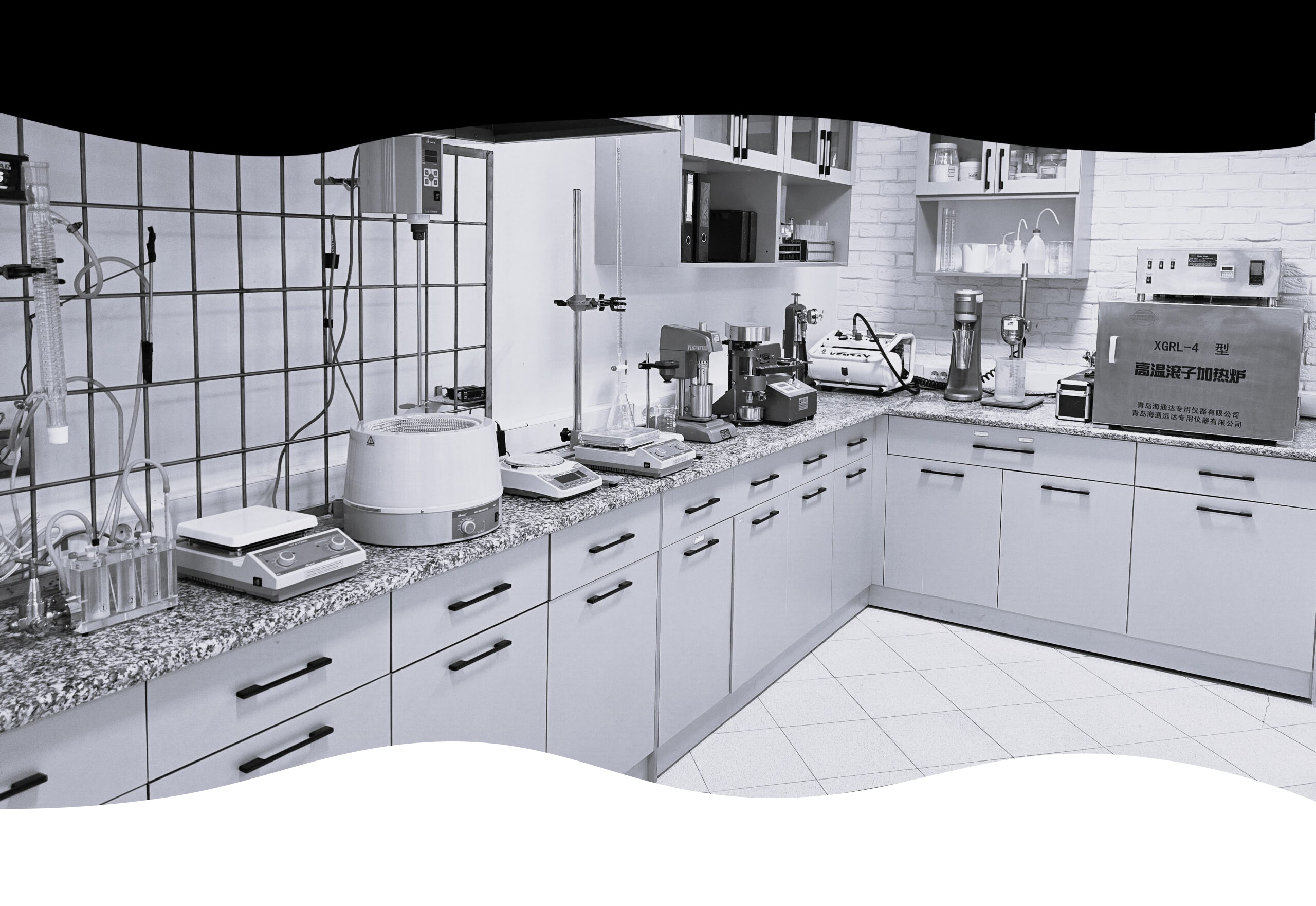
Our performance laboratory is dedicated to conducting chemical and physical tests to assess and certify all products. We also carry out chemical and physical analyses, as well as quality control across the production process.

We meticulously analyze every characteristic of each product, optimize formulations from a chemical standpoint, and evaluate the qualitative consistency of all components with scientific precision.
ss3s 1
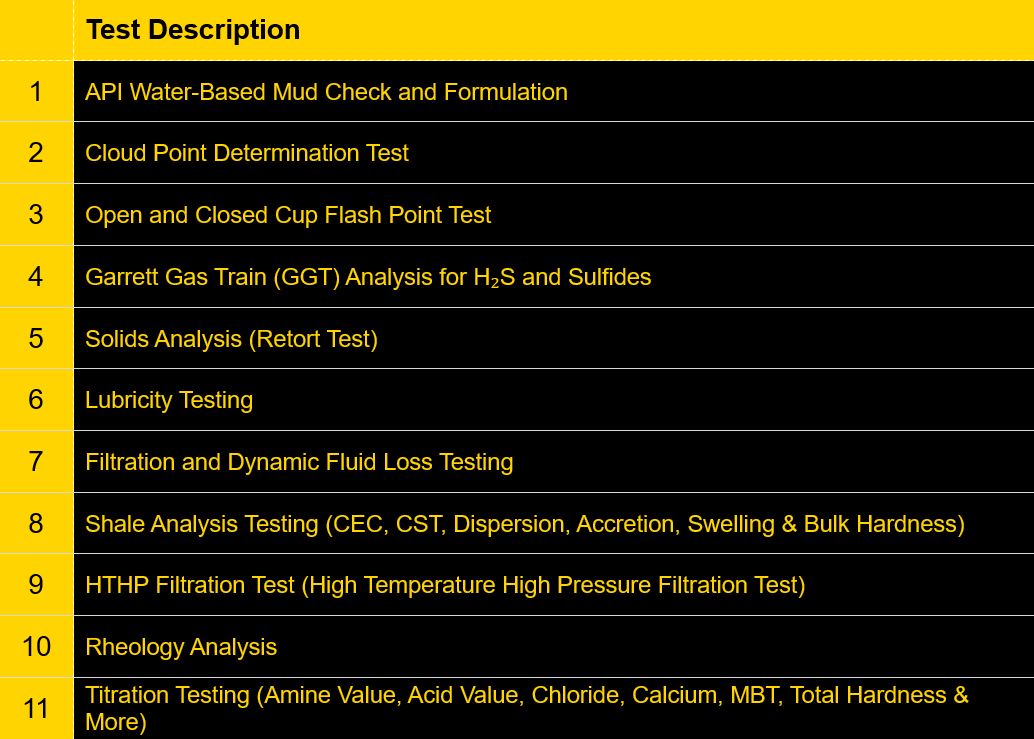
API Water-Based Mud Check and Formulation
Testing and formulation of water-based drilling muds according to API standards, including rheology, density, fluid loss, pH, Marsh Funnel Viscosity, and solids analysis to optimize drilling performance, wellbore stability, and fluid efficiency. Comprehensive laboratory evaluation and formulation of water-based drilling fluids in accordance with API standards. The testing program includes measurement of mud density, rheological properties, fluid loss, pH, salinity, sand content, and filtration characteristics. Based on the test results, mud formulations are optimized to ensure wellbore stability, efficient cuttings transport, minimized formation damage, and compliance with drilling performance requirements.
Lubricity Testing
Measurement of drilling fluid friction-reducing properties using a lubricity tester to determine the Coefficient of Friction (COF). The test evaluates the effectiveness of lubricant additives in reducing torque, drag, equipment wear, and sticking tendencies, thereby enhancing drilling efficiency and wellbore performance.
Cloud Point Determination Test
Determination of the temperature at which wax crystals first form in petroleum products or chemical solutions, causing the fluid to become cloudy. This test is used to evaluate low-temperature performance, wax precipitation tendencies, and flow assurance characteristics in accordance with ASTM D2500 and related industry standards.
Open and Closed Cup Flash Point Test
Determination of the lowest temperature at which a petroleum product or chemical generates ignitable vapors under specified test conditions. Flash point testing is performed using ASTM D92 (Open Cup) and ASTM D93 (Closed Cup) methods to assess product safety, flammability, storage requirements, and regulatory compliance.
Garrett Gas Train (GGT) Analysis for H₂S and Sulfides
Determination of hydrogen sulfide (H₂S), acid-soluble sulfides, and total sulfide contamination in drilling and production fluids using the Garrett Gas Train method. The test supports H₂S hazard assessment, corrosion control, drilling fluid quality monitoring and evaluation of sulfide treatment programs in accordance with API RP 13B procedures.
Solids Analysis (Retort Test)
Determination of water, oil, and total solids content in drilling fluids using a retort apparatus. The test is used to monitor drilling fluid composition, evaluate solids control efficiency, optimize mud properties, and maintain drilling performance in accordance with API RP 13B standards.
Filtration and Dynamic Fluid Loss Testing
Evaluation of drilling fluid filtration characteristics under static and dynamic conditions to determine fluid loss, filter cake quality, and formation protection performance. The tests are used to optimize fluid loss control additives, minimize formation damage, improve wellbore stability, and enhance drilling efficiency in accordance with API RP 13B standards.
Shale Analysis Testing (CEC, CST, Dispersion, Accretion, Swelling & Bulk Hardness)
Comprehensive evaluation of shale-fluid interactions to assess shale reactivity, hydration, swelling, dispersion, accretion, and mechanical stability. These tests are used to optimize drilling fluid formulations, evaluate shale inhibitors, improve wellbore stability, and minimize drilling-related formation instability problems.
HTHP Filtration Test (High Temperature High Pressure Filtration Test)
HTHP Filtration Test is a laboratory test used in drilling fluid engineering to measure the amount of fluid loss from drilling mud under simulated downhole conditions of high temperature and high pressure. In the test, a mud sample is placed in a sealed cell, heated to a specified temperature, and subjected to high pressure across a filter medium. The volume of liquid that passes through the filter in a set time (usually 30 minutes) is recorded as the HTHP filtrate. The test helps evaluate the mud’s ability to control fluid loss, form a good filter cake, and maintain wellbore stability under extreme drilling conditions.
Rheology Analysis (of drilling fluids)
is the evaluation of how drilling mud flows and deforms under different shear conditions. It is used to understand the fluid’s viscosity behavior and its ability to carry cuttings, suspend solids, and circulate effectively in the wellbore. The analysis typically includes measurements such as plastic viscosity (PV), yield point (YP), and gel strength, often obtained using a rotational viscometer. These parameters help determine the fluid’s flow characteristics at both low and high shear rates. Rheology analysis is essential for optimizing drilling performance, ensuring efficient hole cleaning, and maintaining well control and stability
Titration Testing (Amine Value, Acid Value, Chloride, Calcium, MBT, Total Hardness & More)
Comprehensive chemical analysis using industry-standard titration methods to determine the concentration of active ingredients, salinity, hardness, reactive clays, and other critical parameters in drilling fluids, production chemicals, brines, and water systems. These tests support quality control, product development, contamination monitoring, and optimization of oilfield chemical performance.